Lucy Goosie’s Diner
This was a collaboration with the artist Aaron Lopez-Barrantes, whose “Realities of Life” served as inspiration for the story. Click here to read it on Aaron’s Substack.
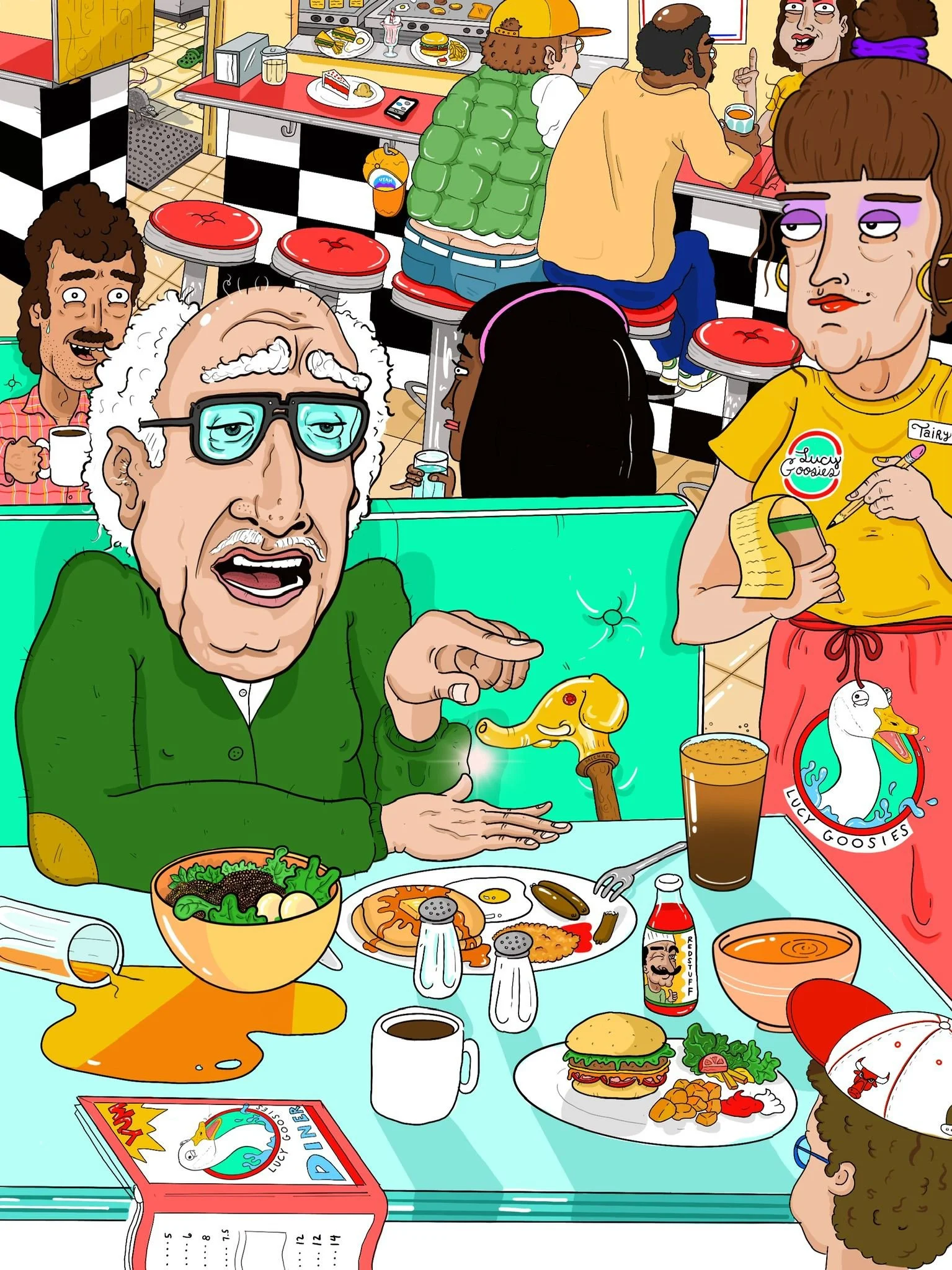
Find Aaron’s artwork here: https://artbyalb.substack.com
Meyer could tell what day of the week it was by looking at Tairy’s makeup. Today, the waitress wore bold violet eyeshadow that matched the scrunchie in her hair, though it also accentuated the dark circles under her eyes. Tuesday, then. All the regulars of Lucy Goosies diner felt that purple wasn’t Tairy’s color, but their collective opinion was outranked by a singular vote because Mac had told her once, between sips of burnt coffee, that he liked her “eye color stuff.” After that, she’d taken to wearing the same shade every time he came in, which, luckily for the diners’ patrons, was only once a week, when Mac’s trucking route took him through Kingman, AZ.
The small city on Route 66 had two claims to fame, each as outmoded as the other: the first was its self-professed title of “Turquoise Capital of the World,” though hardly anyone had cared about the sky-blue stone since the mining boom of the late 1800’s; the second was its status as hometown of Andy Devine, a character actor best known for his work in westerns, back when movies were still black and white and people from nobody-knows towns could not only harbor but actually realize their dreams. But turquoise and Andy Devine aside, nothing much ever happened in Kingman, and so the town had slumped into a dusty, disused corner of History’s past.
Perhaps the only thing keeping Kingman in the present was Lucy Goosies, sandwiched as it was between the post office and the distillery, and sitting across from a lot that had been empty a decade and counting. The diner — which had been proudly serving residents of Kingman since 1986 — was the only business in town whose doors were still regularly greased by the comings and goings of customers, and for this, it was a sacred place, an affirmation of life and resilience out in the Arizona desert.
Not that you would have known it by the look of the old man who made his way to his usual booth, shuffling and grunting as he advanced.
“Morning, Meyer,” Tairy called from behind the red counter, as she distributed two slices of cherry pie to a pair of sleepy-eyed truckers. “Have a seat, I’ll be right there.”
“Thank you, dear,” Meyer wheezed, grunting into position across from the boy.
Wheezing was new for Meyer — he’d accepted that he was getting older, felt his joints ache more each morning as he rose from bed, but this new timbre in his voice bothered him. He’d been a radio man, after all, delivering local news and smooth jazz to all of Mohave County since 1973, which was how Rosie had found him in the first place and how he still liked to think of himself now, as syrupy and smooth as the songs he used to play on 99.6 FM. He hoped that when Rosie read his letters, she continued to hear them in his younger voice.
“You’re late,” the boy said, looking up from the menu on which he’d been drawing a picture of a spaceship.
“And you’re too young to be drinking coffee,” Meyer said, gesturing to the mug which sat in front of the kid.
The boy shrugged. “I just wanted to see what it tastes like.”
“You’ll have plenty of time to try that stuff in the years to come,” Meyer grunted, resting his cane delicately on the seat next to him. He and Rosie had found the cane at a thrift market in Nothing, AZ, backin the summer of ’86, the gold elephant’s head on the handle catching their eye as it glinted in the sun. He patted the elephant gently, now, as though thanking it for its loyal service.
Tairy appeared at the table. “The usual, I assume?” she asked, already scratching Meyer’s order onto hergreasy notepad. 1 full English, 1 Coke (LARGE).
The old man nodded, then gestured across the table. “You gave the boy coffee?”
“It’s decaf,” Tairy said, with a wink. “No need to call the police, you old geezer.”
Meyer’s daily pilgrimage to Lucie Goosies was not, as some in town believed, because he had nothing better to do with his days. Anyone who paid attention to the old man’s comings and goings might realize that he made not one but twostops on his morning walk into town, and that, before stepping into the diner, he first climbed the ramp to the post office and dropped a letter at the counter.
Rosie had stopped writing years ago, but Meyer knew for a fact that she was still alive (he’d called her house in Silver City six months ago) and that she appreciated his writing (“Your letters are the highlight of her day,” Rosie’s daughter told him, when she’d picked up the phone. “She waits until she’s finished dinner to read them every evening.”). It had been twenty-three years since he and Rosie spent a night dancing together, fourteen since they’d last set eyes on each other, and nine since she got diagnosed with dementia and had to move in with her daughter. Still, it was the greatest love story Meyer had ever known — and he’d known a fair number in his eighty odd years— so it was without hesitation that he sat at his dining table every morning and wrote as the sun rose.
Only after he’d licked the envelope shut would he head out the door, envelope in one hand, cane in the other. He’d greet Doris, who was always sitting behind the counter with her chin in her hands, and talk about the weather while fishing in his corduroy pockets for the 59 cents of postage. Then, finally, he’d make his way to Lucy Goosies a door over, his sense of accomplishment feeding his hunger.
This morning, Dave and Anita were at it again. They’d chosen the booth behind Meyer’s for the fight, she watching him with cool precision, a glass of iced water in hand, ready to be thrown at a moment’s notice, while Dave stammered and sweated his way through another explanation of why he hadn’t come home Friday. Anita said nothing because there was nothing to be said — everyone knew she was going to forgive him, and everyone knew that they’d be back in the diner having this same conversation the following week.
“Do they hate each other?” the boy leaned across the table to whisper to the old man.
“They love each other, believe it or not,” Meyer said. “That’s the problem.”
The boy looked confused, then crestfallen. “Why is love a problem?”
A hand landed on Meyer’s shoulder. Tairy deposited a plate of eggs, sausage and hash browns in front of him.
“Take it easy on the kid,” she said, then turned to the boy. “Nice hat, by the way.”
The boy beamed and ran a small hand over the rim of his cap.
“Did you know the Bulls are the only team in the whole NBA that’s never changed their logo?” Meyer asked.
“So they’re a classic,” Tairy said.
“Or they’re stuck in the past,” Meyer grunted.
The door jingled with the arrival of a new customer.
“Hey, Mac,” Tairy called out, her voice soaring. “I’ll be right there.”
“What were you saying before?” the boy asked, once Tairy had disappeared. “About love?” He was looking at him seriously from across the turquoise tabletop.
Meyer paused, taking in the sight of the boy in his baseball cap, which Meyer knew was the one his father had sent for his birthday. He thought about how Tairy still hoped for love every Tuesday. And he imagined Rosie sitting in a rocking chair on her front porch, reading his letters every night in his old voice.
“Love,” Meyer began. “Well, it’s all we’ve got in this old world, isn’t it? It’s what makes each day worth living.”
The boy sagged with relief.
“But you’ll have plenty of time to figure that out for yourself,” Meyer smiled. “For now, drink up. Your coffee’s getting cold.”